Photoshop vs Canva: The Complete Guide to Choosing Your Perfect Design Tool



Razer Project AVA: Your AI Desk Companion – The Future of Digital Friendship or a Privacy Nightmare?
When Razer unveiled Project AVA at CES 2026, the internet collectively lost its mind. A 5.5-inch holographic anime-style AI companion that sits on your desk, watches what you do, and talks to you throughout the day? It sounds like something ripped straight from a sci-fi anime—and that’s exactly the point. But beneath the flashy holographic display and customizable avatars lies a genuinely intriguing question: are we ready for AI companions that exist in physical space, not just our phones?
Project AVA isn’t just another smart speaker with a voice assistant. This is Razer’s ambitious attempt to create what they’re calling a “Friend for Life”—an AI that lives alongside you, powered by xAI’s Grok engine, capable of analyzing your screen, listening to your conversations, managing your schedule, coaching your gaming sessions, and even providing emotional support after a tough loss. It’s equal parts fascinating and slightly unsettling, which makes it the perfect product to dissect.
What Exactly Is Project AVA?
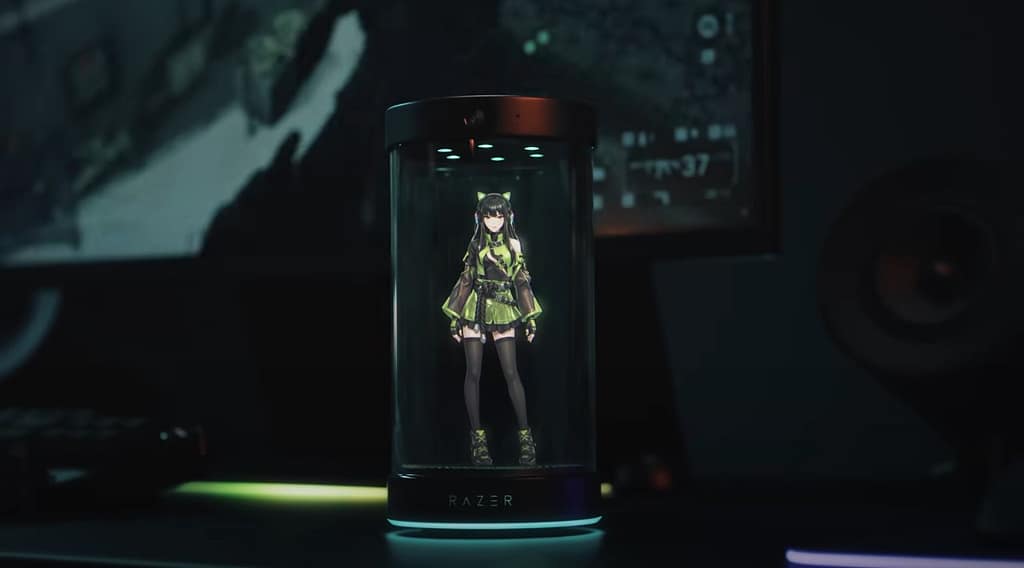
Let’s start with the basics. Project AVA is a cylindrical desk device featuring a 5.5-inch 3D holographic display that projects animated avatars developed by Animation Inc. These aren’t static images—they’re real-time rendered characters with eye-tracking, facial expressions, and fluid motion that respond to your interactions. Think of it as a digital pet mixed with Cortana from Halo, except with way more personality options and significantly better animation quality.
The device packs dual far-field array microphones, an HD camera with ambient light sensor, customizable Razer Chroma RGB lighting (because of course), and a down-firing speaker for audio output. It connects directly to your Windows PC via USB-C, allowing “PC Vision Mode” to analyze everything on your screen—from spreadsheets to game footage—with minimal latency.
Under the hood, Project AVA currently runs on xAI’s Grok engine, though Razer has designed it with an open architecture to eventually support other AI platforms, including their own planned “Razer AI.” This flexibility is actually pretty smart, considering how rapidly the AI landscape shifts.
The Promise: Your All-in-One Digital Companion
Razer positions AVA across three primary use cases, and honestly, they’ve picked their target demographics with laser precision.
For Daily Life Management, AVA acts as your personal organizer—managing calendars, suggesting wardrobe choices, planning meals, tracking wellness habits, and providing motivational reminders. It’s essentially Google Assistant or Alexa, except she exists as a visible character on your desk rather than an invisible voice from a speaker. The psychological difference is surprisingly significant. Having a visible “presence” makes interactions feel more personal and less like you’re shouting commands into the void.
For Professional Work, AVA transforms into an AI consultant capable of creative brainstorming, analyzing complex documents and spreadsheets, summarizing trends, and providing real-time translation for both text and verbal conversations. The ability to visually point at your screen and ask, “What’s wrong with this formula?” or “Summarize the key points from this 50-page report” while an animated character processes and responds creates a workflow that feels genuinely collaborative rather than transactional.
For Gaming—and this is where Razer’s core audience gets excited—AVA becomes your hype woman, strategic advisor, and lore encyclopedia rolled into one. She provides real-time coaching for puzzle solutions, identifies opponent weaknesses in competitive matches, recalls complex in-game information without forcing you to tab out, and most importantly, celebrates your victories and offers encouragement after defeats. Anyone who’s rage-quit a difficult boss fight knows that having someone there saying “You almost had it! One more try!” hits differently than grinding alone in silence.
The Benefits: Why This Could Actually Be Brilliant
There’s genuine value here beyond the novelty factor. For gamers spending 6-10 hours at their desks, having an AI companion that provides contextual assistance without breaking immersion is genuinely useful. Imagine tackling a souls-like boss while AVA analyzes attack patterns and suggests dodge timings, or exploring a massive RPG while she recalls NPC dialogue from 30 hours ago that’s suddenly relevant.
For designers and creative professionals, the brainstorming capabilities could be transformative. Rather than switching between multiple applications to access AI tools, you have a persistent companion that understands your workflow context because she’s literally watching your screen. The visual presence also creates accountability—it’s easier to stay focused when there’s a character on your desk reacting to your productivity (or lack thereof).
The anime enthusiast demographic will appreciate the customizable avatars and the parasocial relationship dynamics. Razer understands that many people already talk to their monitors during gaming sessions or explain problems to rubber ducks while coding. AVA just makes that interaction bidirectional and useful.
The Concerns: Privacy, Dependency, and the Uncanny Valley
Now let’s address the elephant in the room—or rather, the holographic AI lady watching your every move.
Privacy is the biggest concern. Project AVA requires an HD camera pointed at you and microphones always listening for activation. It analyzes everything on your screen in PC Vision Mode. That’s an extraordinary amount of personal data flowing through a device connected to servers running AI inference. Razer claims security is a priority, but we’ve heard that before from tech companies. One data breach, one subpoena, one change in terms of service, and suddenly your AI companion knows an uncomfortable amount about your browsing history, work documents, and late-night gaming confessions.
Psychological dependency is another legitimate worry. When you design something to be a “Friend for Life” that provides emotional support and companionship, you’re deliberately fostering attachment. For people already struggling with social isolation or parasocial relationships with virtual characters, having an AI that responds to your emotions and celebrates your achievements could become unhealthy. There’s a difference between a useful tool and a digital relationship substitute.
The always-watching aspect feels dystopian to many people. Even if you trust Razer’s security, the concept of a device that sees your screen, hears your conversations, and analyzes your behavior patterns 24/7 crosses boundaries that previous smart assistants didn’t. Alexa sits in the corner and activates when summoned. AVA is visually present, animated, and contextually aware of everything happening at your desk.
Performance and accuracy concerns are practical issues too. AI hallucinations, misinterpreted commands, and incorrect information could range from annoying to genuinely harmful depending on the context. If AVA misreads a spreadsheet and gives bad financial advice, or provides incorrect strategy coaching that costs you a ranked match, the trust breaks down fast.
The Verdict: Innovation With Asterisks
Project AVA represents genuine innovation in human-AI interaction. The holographic display, real-time contextual awareness, and persistent companion model push boundaries in ways that could define how we interact with AI moving forward. For gamers, anime fans, and creative professionals willing to embrace the concept, there’s legitimate value here that justifies the (currently unannounced) price tag.
But that value comes with serious privacy trade-offs and psychological considerations that shouldn’t be dismissed. This isn’t a product everyone should buy, even if they can afford it. If you’re uncomfortable with cameras and microphones actively monitoring your workspace, if you’re concerned about data security, or if you recognize tendency toward unhealthy parasocial attachments, Project AVA probably isn’t for you—and that’s okay.
For those willing to accept the risks, Project AVA arrives in the second half of 2026 with reservations currently open for $20 (fully refundable). Whether it becomes the future of AI companionship or a cautionary tale about technology going too far remains to be seen. One thing’s certain though—Razer has created something that will force conversations about where the line between useful tool and digital relationship actually exists.
And honestly? That conversation is probably overdue.